White Korean ginseng
Of the real Ginseng (Panax) there are 2 varieties that are mainly used for beneficial purposes. The Asian Ginseng is called Panax CA Meyer, also called Panax Ginseng and Korean Ginseng, and the North American Ginseng is called Panax Quinquefolium (also called American ginseng).
Typically for all the ginseng species of the genus Panax are the presence of the so called ginsenosides; the active components of ginseng.
Introduction
Korean Ginseng is a salutary plant, from which the root is harvested after a long and costly growing period of 5 to 8 years. Especially the dried ginseng root has been appreciated and used for thousands of years in China to bring the body and mind back into the natural balance. Ginsengs properties are both preventive and curative.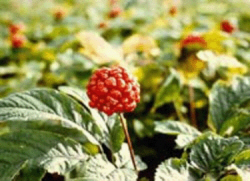
|
Photo: mature ginseng berries containing the ginseng seeds. |
|
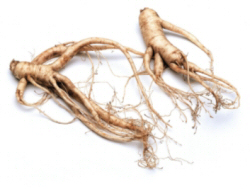
Photo: Fresh ginseng roots, regarding their shape like a human body also called man root. |
Application
Of the Korean ginseng plant mainly the dry roots are used for salutary purposes.In China also the dried leaves and the flower buds are consumed as a tea. A recent application is to extract made from using the berries to prevent hunger by reducing the extract keeps the blood sugar normal.
Korean Ginseng is mainly used internally as a food supplement and as a functional ingredient in food and (energy) drinks.
Increasingly the extract is added to cosmetic products to support the regenerative capacity of the skin and for maintain healthy cells and tissues..
Beneficial for:
A typical feature of the so-called Korean Ginseng has adaptogenic effect; the self-adjust to each circumstance.Korean Ginseng is mainly used to bring the body and mind in balance and / or maintain. Korean Ginseng therefore works well for maintaining health and in recovery periods.
According to the Dutch Guidelines KOAG / KAG allowable terms, related to this product, are:
- Support for stress and tension.
- Gives more energy and increases endurance.
- Stimulates the immune system and promotes the (natural) immune system of the body cells.
- Blood purifying and improves blood circulation.
- Good for heart and blood vessels.
- Beneficial effect on human health, strengthens the vitality.
- Aphrodisiac and libido-generator.
- Promotes a normal regular menstruation.
- Helps menopausal symptoms.
So far, the European Food Safety Authority (EFSA) has not approved any of the submitted health claims for this product or its components, and these should therefore not be used in the EU.
Industrial applications
The various components in Korean Ginseng have a strong antioxidant effect. These properties can be applied among others for the replacement of sulphite in the wine production and for preventing the colouring of prepared meat products.Dosage
As an optimal daily dosage for an adult 1-2 gram of the raw herb is advised. As a high dosage sometimes 4-5 gram per day is used. For a dosage of more than 10 gram per day it is recommended to do so only under supervision of an expert.Of Korean Ginseng extracts and/or extracts powders with an 8% ginsenoside content a daily dosage of 400-800 mg is recommended. Of extract powders with a 30% ginsenoside content 100-200 mg is recommended as an optimal dosage.
For an optimal effect of products for external use it is recommended to add 4-6% concentrated Korean Ginseng extract with 30% ginsenoside content.
For a cosmetic effect it is recommended to apply a minimum of 3-6 gram of Korean Ginseng extract powder (30% ginsenoside content) per kilo product.
Contra-indications
- Korean Ginseng is generally regarded as safe. It is not poisonous and as far as known does not have irreversible harmful side effects;
- For an operation it is advised to inform your anaesthetist that Korean Ginseng is used;
- Do not use without supervision of an expert when blood thinners are used;
- Do not use the Korean Ginseng when one has a (too) high blood pressure;
- A strong overdose taken during a long period of time can lead to the so called Ginseng Abuse Syndrome. The symptoms are: sleeplessness, high blood pressure, light depression, tension in the muscles and puffiness (retaining too much fluid in your body).
More information / news
Copyright © 2011 Benseng Foodsupplements BV, Veghel, The Netherlands. See: www.benseng.nl
 |
 |
| previous | next |